

Written by Anonymous
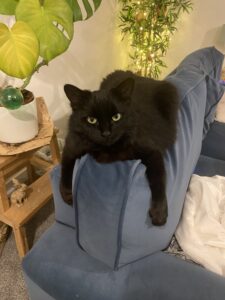
I’m mother to two darling cats and, to my own mother’s eternal disappointment, no human children. This is despite an epidemic of babies in my friend group that makes me think pregnancy must be catching. Still, despite being thirty-three years old, I didn’t actually want to mother the cat. Cats are famously aloof and prefer to treat you more like a live-in butler. No, I would be vastly more chic and find an alternative outlet for the trace amounts of maternal instinct I seem to be saddled with: house plants.
A very good friend of mine has an abundance of plants and a house that always smells like patchouli. She’s always flitting from plant to plant with a watering can, or ruffling their leaves like an affectionate parent. She does Yoga. This could be me, I thought: well-stretched and surrounded by my green children. They would fill my home with oxygen and leafy nonchalance. More water, Margaret? Getting enough light, Gregory? Such perfect earthly beings and I would be Gaia to them, in a verdant world of my own making.
Only it turned out Margaret was getting too much water, and Gregory wouldn’t be happy no matter what kind of light he was placed in. How could plants have too much water, I asked? It’s your life source! Gregory and Mags, the calatheas, not to mention ferns, elephant ears, and unspellable others, turned out to be demanding little plantae, hellbent on withering themselves into early graves.
It was clear to me what was happening. They were rejecting my love. They did not want to live in my house. They seemed not to want to live at all. No, it was back to the cats and just as well, because the vet bills would be very bitter pills to swallow without unconditional adoration. Recently, when a close friend told me she can’t help but sob when her newborn baby cries, I had to resist telling her I knew exactly how she felt. Once, one of my cats had yowled so much at the vets I had been hard pressed to keep my eyes from filling with tears and snatching her back into my arms. New parents are famously touchy though.
I can’t help but think how close I might have come to it myself. Some time ago now, I was at the end of a six-year relationship, where we had reached the inevitable precipice of deciding to get married or call the whole thing off. At the crux of the matter was my own hesitation over wanting children, and my unvoiced fear about committing to a heteronormative partnership. The pain of that separation was like being hollowed out, all the sweet and familiar assurances I had lived with for all those years suddenly coming undone. Maggie Nelson wrote about finding a book titled ‘The Deepest Blue’, a saccharine and simplistic self-help tome for women, but the refrain capturing something of the end of her relationship. ‘This is how much I miss you talking. This is the deepest blue, talking, talking, always talking to you.’ I had gone from the numbness of our slowly disintegrating relationship to unrelenting grief, endless in its depths, that I had lost someone so very important. It was a grief briefly doused, but ultimately made that much worse, by my desperate attempts to repair it. I’m grateful now that he remained so firm and then emigrated to Canada, so the option is really off the table.
No longer being grief-stricken doesn’t mean there aren’t occasional bouts of loneliness. But mostly, solitude is peaceful and I’ve found solace in friends who have taken paths a little more off the beaten track. I’m lucky to know so many women who are happily living their lives, who are fulfilled with their careers, or who take joy in nature. I still think of him, but the shade of the thoughts are green now, not blue.
IncludeAge gives me a hopeful feeling. I have been part of many different research projects, but rarely one that has evoked such community. Hearing stories of love, solidarity, and vulnerability, of people looking out for each other in the places they feel at home. It feels alive, like something growing, stretching, rooting itself deeper with every conversation and workshop. It is green (don’t be fooled by all the yellow branding). There’s a softness to the project that’s rare in academic spaces; a sense that people aren’t just participants, or co-researchers, or data points, but co-creators, each holding and sharing their own wisdom.
The LGBT+ stories in the project have quietly, steadily shifted something in me. Listening to people speak so openly about their relationships, their identities, their journeys toward self-acceptance has made space for my own. As a queer woman, I’ve spent years learning how to feel at home in that part of myself, sometimes confidently, sometimes with hesitation. But in IncludeAge, these narratives of pride, resilience, tenderness, and joy have felt like a doorway to a community I had never felt truly part of before. They’ve helped me recognise my own queerness not as something to name cautiously, but as a source of belonging, friendship, and acceptance.
What has struck me is how naturally people step into that shared space, from both LGBT+ and learning disabilities communities. They speak with frankness, with humour, with a willingness to share parts of life that are messy or overlooked. IncludeAge is a reminder that community isn’t abstract. It’s built moment by moment, in gestures of honesty and care. This project shows how research can nourish something real, living, and meaningful, and I am deeply grateful to be a part of it.
